
AEROPUERTOS MEXICANOS
Sustainability

Level 2 Airport Carbon Accreditation

Tepic–Riviera Nayarit and Puerto Escondido international airports have earned Level 2 Airport Carbon Accreditation, an international recognition of how they manage their carbon footprint.

Airport Carbon Accreditation, Level 2

The accreditation builds on the sustainable-development work in the master plans for both airports. Together with the municipalities of Xalisco, in Nayarit, and San Pedro Mixtepec, in Oaxaca, and with the state governments, each project was aligned with a responsible use of local resources.

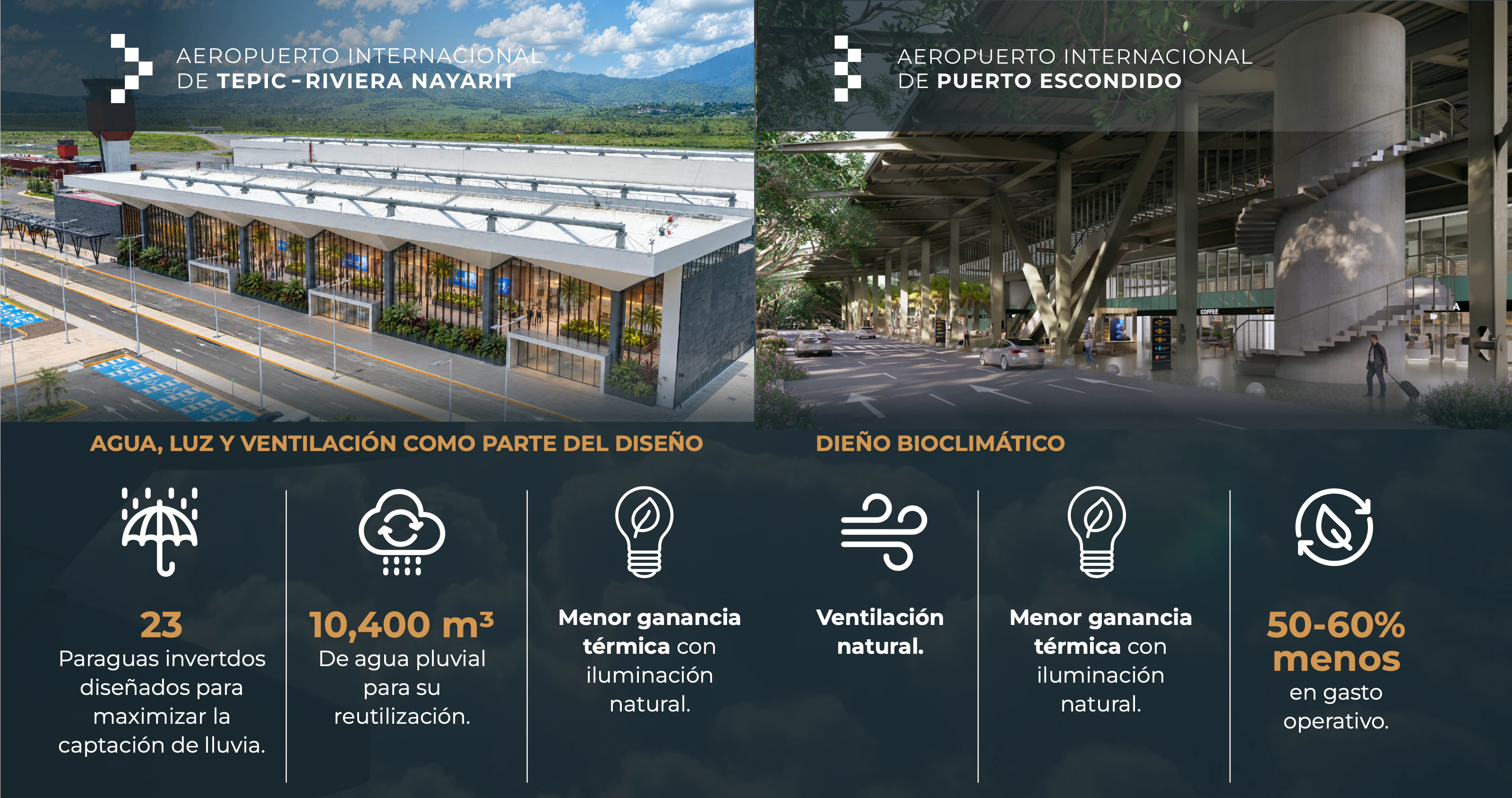
Sustainability infographic: Tepic–Riviera Nayarit with water, light and ventilation; Puerto Escondido with bioclimatic design.
Aeropuerto Internacional de Tepic-Riviera Nayarit

Tepic–Riviera Nayarit International Airport

The building’s orientation, daylight and a roof that captures rainwater concentrate the measures in the new terminal.

  • The landside façade faces east and the airside façade faces west. Tempered glass and vertical aluminum elements bring daylight into the terminal. The north and south façades, parallel to the runway, open the building to the prevailing winds.
  • A protective film cuts solar heat gain by 85%. Aluminum fins at 30° provide shade and help limit air-conditioning use.
  • The roof is made of 23 inverted umbrellas, each 26 by 16 metres — about 9,660 m² — suspended more than 18 metres above the floor. They can capture more than 10,400 m³ of rainwater, about four Olympic pools or two professional soccer pitches, stored in a storm pond and reused for irrigation and cleaning.
Aeropuerto de Puerto Escondido

Puerto Escondido International Airport

The new terminal is designed for the coastal climate: passive ventilation and natural light, local and national materials, and landscaping that respects native species.

  • The design aims to cut operating and maintenance costs by 50% to 60% compared with a conventional terminal.
  • Beach airports handling 1 to 5 million passengers a year typically use 4 to 5 kWh per passenger. Puerto Escondido’s new terminal is designed for 1.5 to 2.5 kWh per passenger.
  • The airport is registering as a qualified user so it can purchase renewable energy and reduce traditional electricity use by up to 70% per passenger.

Water

Both airports have treatment plants for wastewater and for blue water from aircraft lavatories.